Calligraphy Practice Phrases: Short Lines Written for Beginners
A set of short original phrases grouped by the skill they train: arches, ovals, loops, descenders, capitals and mixed lines, with a simple way to practice each one.
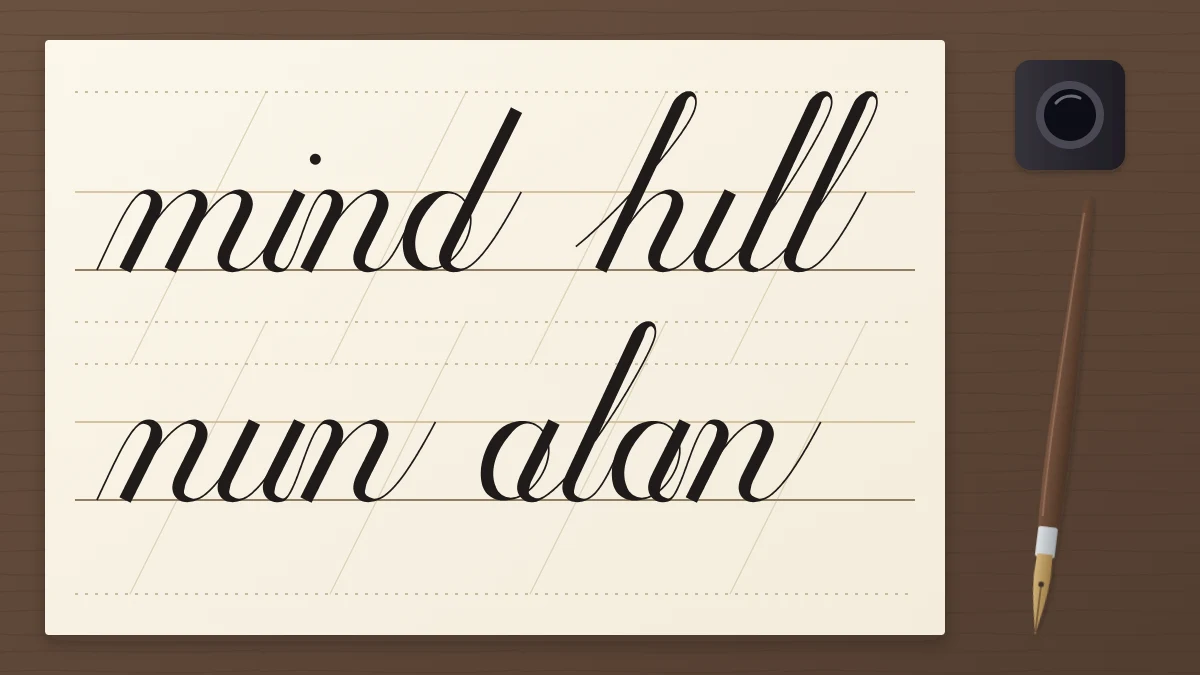
Once single words feel manageable, the question becomes what to write next. Copying famous lines is the usual answer, but those lines were chosen for their meaning, not for the strokes they contain, and they often hide the very letters you need to work on.
The calligraphy practice phrases below were composed for this site with a different aim. Each one is short, plain and built around a particular group of letters, so a few minutes with it trains a specific skill. They are grouped by what they exercise, from steady arches to capitals.
How to practice a phrase
A phrase adds something a single word does not: the spaces between words and the length of the whole line. A simple routine keeps both under control.
- Pencil the line length first. Write the phrase lightly in pencil, at full size, to see how far it runs. Make a small tick where it ends.
- Write it in ink or brush pen. Go slowly, stroke by stroke, and aim to finish near the tick.
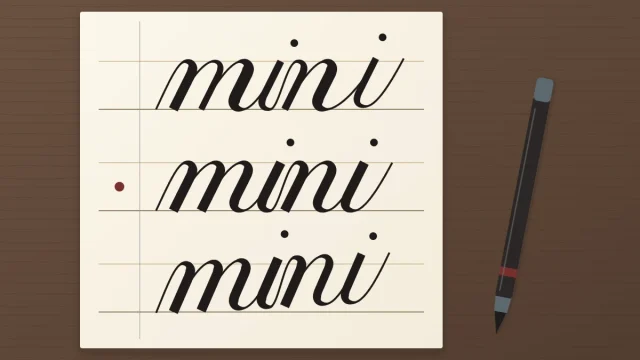
- Write it three times. Use a fresh row for each attempt and change one thing each time, such as a tighter word space or a steadier slant.
- Compare. Look at the three rows together, mark the strongest and note in a word or two why it works.
If the individual words give you trouble, step back to single word practice for a session and return to the phrase afterward.
Arches and rhythm
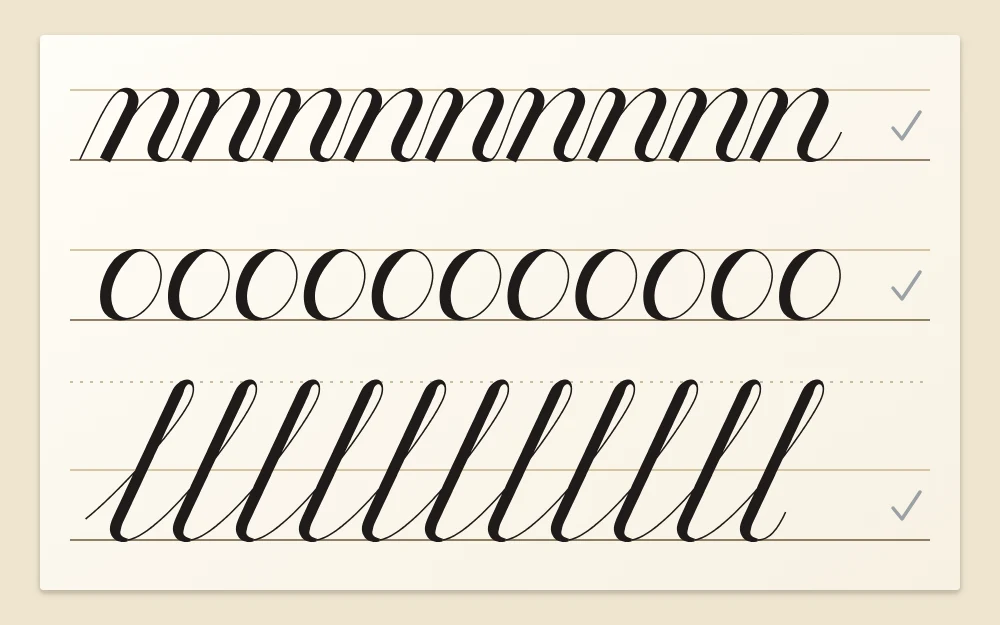
These lines are packed with m, n, u and i, so they are mostly straight downstrokes at regular intervals. They train even spacing and a steady beat, and they show a drifting slant right away.
- nine warm minutes
- a minimum of mint
- mum hums a new tune
- in an unhurried rhythm
Watch the fence-post pattern of the thick strokes. In “a minimum of mint”, every downstroke should look the same distance from the next.
Ovals
Here the letters a, c, d, e, g, o and q do most of the work. The aim is ovals of one size and one lean, each just touching the hairline that leads into it.
- a good cocoa day
- odd socks and a coat
- dad cooked a good egg
- a quiet oak door
Round letters next to each other need to sit close. In “a good cocoa day”, check that the paired o shapes match and that no gap opens between c and o.
Loops, ascenders and descenders
Ascenders
Tall letters such as l, h, b, k, t and d set the upper edge of a line. These phrases train you to bring every ascender to the same height and keep long downstrokes parallel.
- tall hills, little bells
- hold the ladder still
- a kettle and a thimble
- hello, little bluebell
Double l appears in almost every line on purpose. The two loops should look like twins, with the same width and the same slant.
Descenders
The letters g, j, p, q and y drop below the baseline. Practice keeps their loops the same depth and stops them from swinging to different angles.
- a happy, jumpy puppy
- jog by the gray jetty
- a young poppy in a jug
Leave enough room under the row before you start. If you plan to stack lines, a descender on one row can collide with an ascender on the next, so space your guidelines generously.
Capitals
Capitals appear rarely in ordinary text, so they need lines written specially for them. These use common first names, days and months to give each capital a few lowercase letters to lead into.
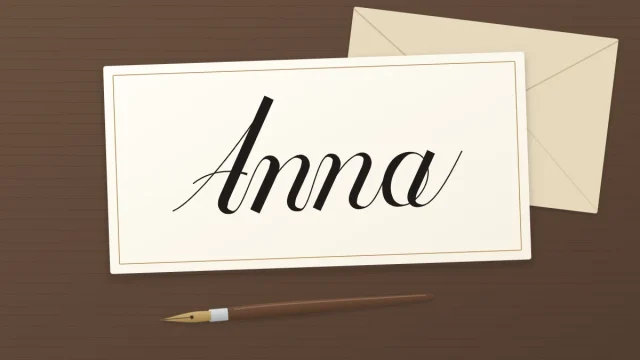
- Anna and Leo at Noon
- Dear Mia, Hello from Maine
- Open Late on Friday
- Monday, March, Morning
Check that each capital matches the weight and slant of the small letters after it. The last line repeats one capital three times, which makes any change in its size or shape easy to see.
Mixed lines of four to six words
When the single-skill groups feel comfortable, mixed lines bring everything together: arches, ovals, loops, descenders and several word spaces in one row.
- a quiet lamp by the window
- fold the blue quilt neatly
- seven pale moths at dusk
- bring the jam jar home
Longer lines tend to climb, shrink or lean further as they go. Compare the last word with the first, and keep the word spaces about as wide as one of your lowercase o shapes.
Tip
Pick one phrase from one group for a session instead of sampling them all. Three careful rows of a single line will show you more than one hurried row of ten different lines.
Which group to choose
Let your last practice page decide. Look at it for the fault that appears most often, then choose the group that works on it.
| What you notice | Group to practice |
|---|---|
| Uneven gaps, changing slant | Arches and rhythm |
| Ovals of different sizes | Ovals |
| Tall letters at different heights | Ascenders |
| Tails that tangle or vary in depth | Descenders |
| Capitals that look heavy or upright | Capitals |
| Lines that drift or run out of room | Mixed lines |
To fit this into a regular week, the guide to building a practice routine suggests how to divide a short session between warm-up strokes, letters and lines such as these.
Write your own phrases
Composing a practice line takes a couple of minutes, and a line of your own is tuned to exactly the letters you want.
- Choose the two or three letters you most want to improve.
- List six to eight everyday words that contain them, preferably more than once.
- Arrange three to five of those words into a short line that reads naturally. It does not have to be clever; “pale plums on a plate” is enough.
- Count the ascenders and descenders, and swap a word if the line is crowded above or below.
Describing what is in front of you works well: the objects on your desk, the weather outside, what is in the kitchen. Plain subjects give plain words, and plain words keep your attention on the strokes.
Keep a running list of your lines at the back of your practice pad. When one starts to look settled, it is a good candidate for a small finished piece, and the guide to planning a layout shows how to center a short phrase and break it across two rows.
Frequently asked questions
What should I write when practicing calligraphy?
Short lines that repeat the letters you are working on are the most useful. A phrase of three to six plain words, built around one group such as arches or ovals, lets you practice joins, word spaces and line length without the distraction of a long text.
How long should a calligraphy practice phrase be?
Three to six words is a comfortable range for a beginner. That is long enough to include a few word spaces and to test whether your slant holds across a line, and short enough to write three times in one sitting and compare the attempts.
Can I make up my own calligraphy practice phrases?
Yes, and it is a good habit. Pick the letters you want to improve, list everyday words that contain them, and arrange a few into a short line. A phrase you composed yourself targets your own weak spots and is entirely yours to use in finished pieces.