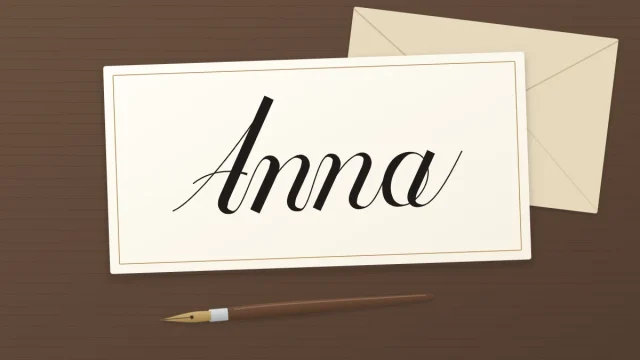
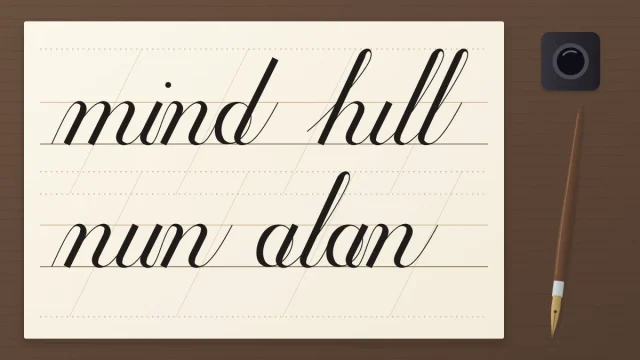
Calligraphy Word Practice: Your First Words, Letter by Letter
Move from letters to whole words with a clear plan: short words from one stroke group at a time, then mixed words, each written three times and checked for slant and spacing.
Practice at a glance
What you need
- Smooth practice paper
- Pencil and ruler
- Small-tip brush pen or pointed nib in a holder
- Ink, if using a dip pen
- Eraser
Single letters are tidy to practice because each one starts fresh. A word asks for more: several letters in a row, every join landing in the right place, and slant and spacing holding steady from the first stroke to the last.
The gentlest way in is structured calligraphy word practice, where the first words use only one family of strokes and new shapes are added a group at a time. The words below are everyday words chosen for their shapes, not their meaning.
Before you write a word
You will need ruled guidelines with a baseline, a waistline and slant lines, plus an ascender and a descender line for the later groups. Use the pen you practiced your letters with, at the same letter size.
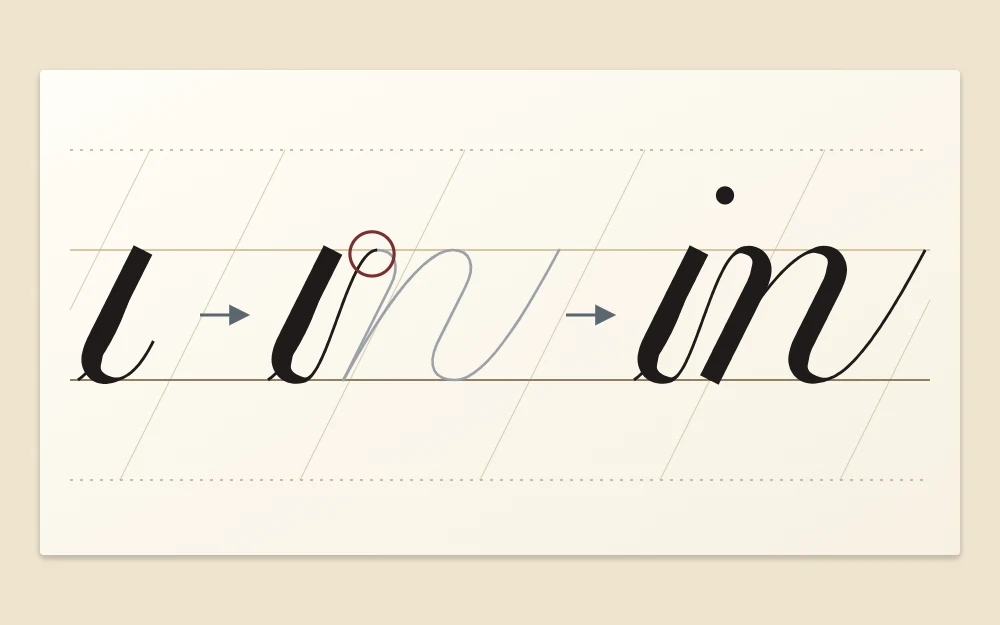
Words also depend on joins. If you have not yet practiced letter pairs, work through the guide to connecting letters first. A word is simply three or four of those pairs in a row.
A four-step routine for every word
Use the same routine for each word in every group. It keeps the practice slow enough to learn from.
- Plan the joins. Look at the word and name each connection: low join into a stem, low join into an oval, or high join. Lightly pencil the word if that helps.
- Write slowly, stroke by stroke. Build each letter from its strokes and lift between them. Let each exit hairline carry you to the start of the next letter. Add dots and crossbars after the last letter.
- Check slant and spacing. Compare the downstrokes with your slant lines, then look at the white spaces between them.
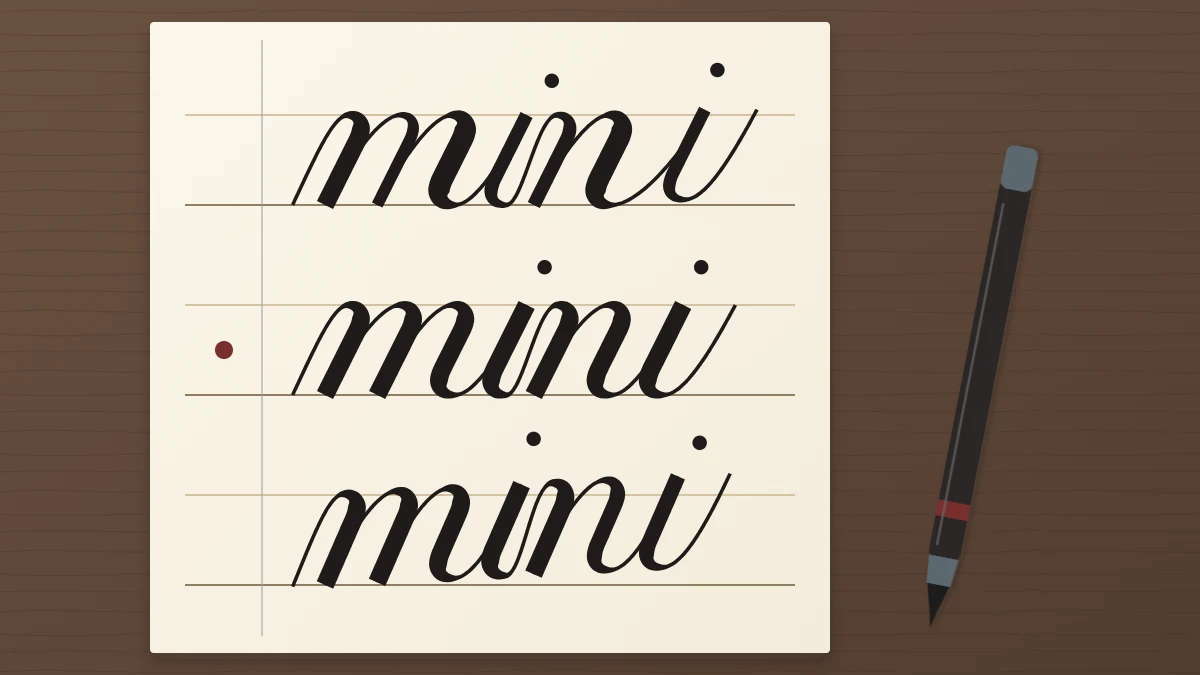
- Repeat three times and mark the best. Write the word twice more underneath, changing one thing each time. Put a small pencil dot beside the strongest attempt.
Marking the best attempt matters more than it seems. It trains you to see what worked, and it gives you a target to compare with at the next session.
Group 1: underturn and overturn words
Start here. These words are made almost entirely of straight downstrokes with arches at the top or bottom, so the rhythm is easy to see and every join is a low one.
- in: one join; a good first word.
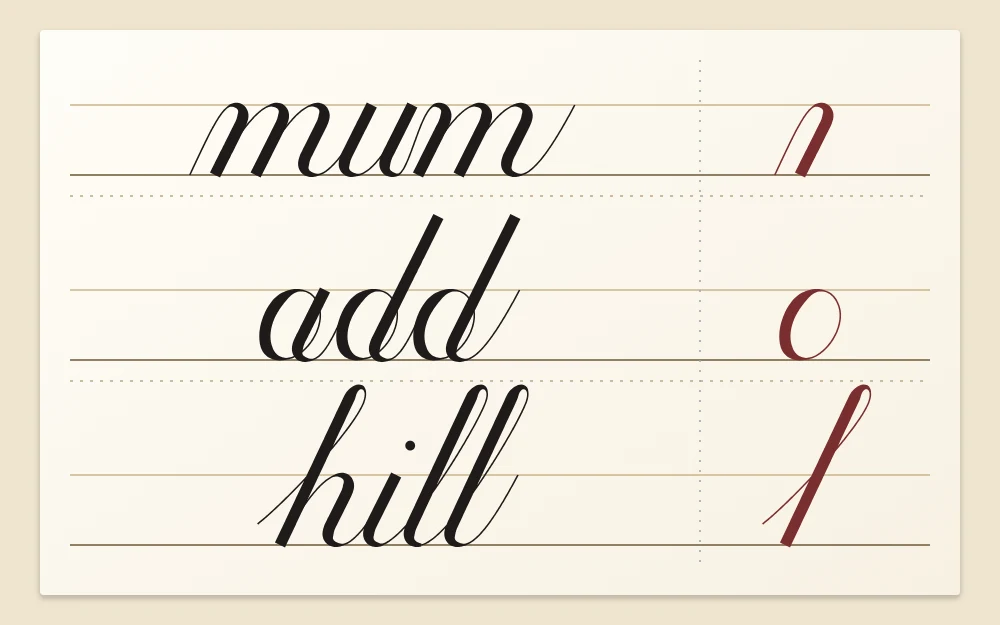
- mum: seven downstrokes that should look evenly spaced.
- nun: overturns, an underturn, then overturns again.
- mini: arches plus two dots to place at the end.
- unit and mint: add a taller t and its crossbar.
Watch for letters blending into one another. In “mum” it should still be possible to tell where the m ends and the u begins, because the turn at the baseline is narrow and the arches at the waistline are round.
Group 2: oval words
Now the hairline has to meet a round shape. Each join rises toward the waistline, you lift, and the oval is written so that its right shoulder just touches the hairline.
- add: three ovals in a row and a double letter.
- dad: tall stems on both sides of a small a.
- good: a descender, two matching ovals and a high join from each o.
- ago and code: extra variety once the first three feel steady.
Watch that every oval is the same size and leans the same way. In “good”, the two o shapes are a direct test: if one is rounder or more upright than the other, it will show.
Group 3: loop words
Loops bring height and depth into the word. The long downstrokes make any change in slant obvious, so slow down on them.
- hill: three ascending loops, two of them a matching pair.
- ball: an oval tucked against the first loop, with a high exit from the b in many styles.
- joy: two descending loops with an oval between them.
- hobby and jolly: longer words mixing both kinds of loop.
Watch the loop tops and bottoms. Ascending loops should reach the same line, and descending loops should drop the same distance. In “hill”, lay a ruler lightly across the tops to check.
Group 4: mixed words
When the first three groups feel familiar, combine them. Each of these words uses at least two stroke families and one join that needs thought.
| Word | What it mixes | Join to plan |
|---|---|---|
| hand | Loop, oval, arch | n into the oval of d |
| mango | Arches, ovals, descender | g up into o |
| lemon | Loop, arches, oval | High join from o to n |
| window | Underturns, oval, loop stem | Two high joins after w and o |
| yellow | Descender, double l, oval | Matching loops in the middle |
Longer words tend to drift, climbing above the baseline or leaning further as they go. After each one, check the last letter against the first: same size, same slant, same weight.
Tip
If one join keeps going wrong, take that pair of letters out of the word, write a line of it, then put it back. A single stubborn pair is usually the whole problem.
Reading your three attempts
Comparing three versions of one word tells you more than writing it twenty times without looking. Ask the same questions each time.
- Do all the downstrokes follow the slant lines?
- Do the white spaces between downstrokes look equal?
- Do the letters sit on the baseline and reach the waistline?
- Are the thick strokes a similar weight throughout?
If the spaces are the main issue, the guide to spacing letters evenly explains what to look for and how the hairline controls each gap.
How much to do in one session
A handful of words is plenty. Four or five words, each written three times with a real check after each one, fills about 15 to 20 minutes and leaves you with a page you can learn from.
Keep your grip relaxed and pause between words. If something hurts, stop and change your setup before the next session.
Move to the next group when the current one feels comfortable, not on a fixed schedule. When mixed words are going well, short lines of several words are the next step, and the collection of practice phrases is arranged in the same skill-by-skill way.
Frequently asked questions
What are good first words to practice in calligraphy?
Short words made from one family of strokes are the easiest start. Words such as in, mum, nun and mini use only arches and straight downstrokes, so every join is the same kind and the rhythm of the thick strokes is simple to judge.
How many times should I write each practice word?
Three careful attempts are usually more useful than a full line of quick ones. Write the word, check slant and spacing, then write it twice more while changing one thing each time. Mark the strongest attempt so you can see what improved.
When should I move from letters to words?
Once you can write most lowercase letters without stopping to think about their strokes, and you have tried a few letter pairs, short words are a reasonable next step. You do not need every letter to look polished; words themselves are good practice for the letters.